
When the Formula Becomes a Prop: A Cosmetic Chemist on What the Texture Trend Is Actually Costing Us
A professional opinion piece

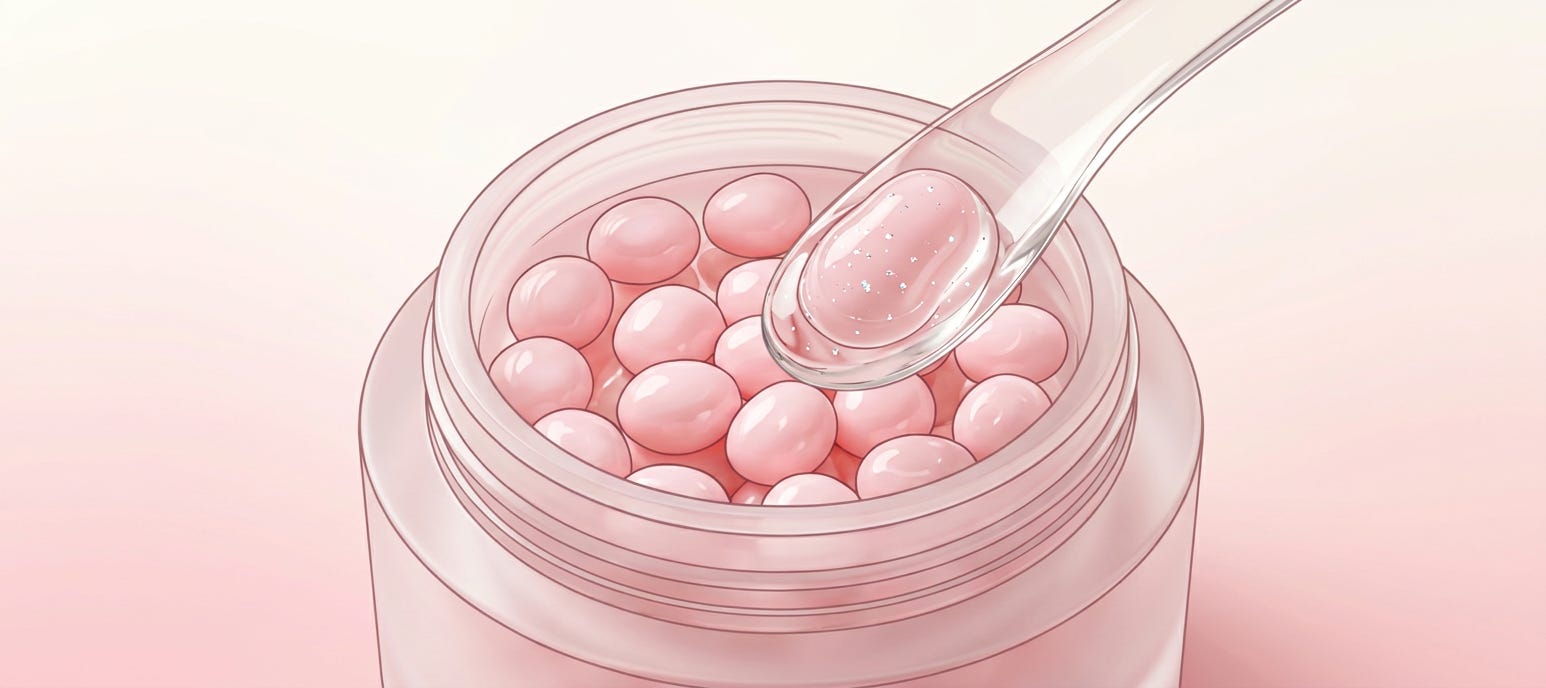
There are four products sitting on my desk right now. They’re all from the same brand. They all promise some version of the same thing: collagen, PDRN, hydration, glow, firmness. They all contain niacinamide, hyaluronic acid, ceramide, and salmon-derived ingredients. If you read the marketing, you’d think these were four products designed for four different skin concerns.
They’re not. They’re the same product in four different costumes.
One is a transparent pink jelly, similar to aloe vera gel, that you scoop with a spoon. One is a clear gel with pink capsules you pop and blend. One is a liquid that dries into a film you peel off in the morning. And one is a jelly that sprays out of a mist nozzle.
Same brand. Same active ingredient story. Four different textures. Four different TikTok moments.
And this is the part I can’t stop thinking about: none of these products needed to exist as four separate launches. One well-formulated leave-on moisturiser with the same ingredients, in a format designed around how those actives actually work on skin, would have done the job. What you’re paying for when you buy all four isn’t four different skin solutions. It’s four different content moments. The jelly scoop. The capsule pop. The peel reveal. The mist transformation.
Each one engineered to stop a thumb mid-scroll.
That’s the business model. And I think we need to talk about what it’s costing us.
The brief has changed
I’ve spent a decade in the cosmetics industry, first as a biochemist testing formulations, now as a cosmetic chemist building them. I’ve watched the development pipeline from both sides, and through all of it, the logic mostly made sense: you identified a skin need, you built a formula to address it, and then you figured out how to tell people about it. The science came first.
What I’m seeing more and more of is the complete inversion of that logic. I don’t need to see the internal briefs to know what’s driving these launches; the products tell the story themselves. When the same brand releases the same active ingredient combination in a jelly one quarter, a capsule cream the next, a peel-off mask after that, and a sprayable mist to round out the year, the pattern is clear: the starting point wasn’t four different skin concerns that happened to require four different formats. The starting point was four different content moments that needed a credible-sounding active story attached to them.
The ingredients become the alibi. The texture is the product.
And the infrastructure exists to do this at industrial scale. The global cosmetics ODM market, the system of contract manufacturers who develop and produce formulas for brands, is forecast to reach USD 30.5 billion by 2036. You can go from a trend spotted on TikTok to a finished product on shelf in eight weeks. Genuine R&D takes years. Guess which timeline wins right now?
ODM isn’t the problem
I want to be clear about this, because I think it gets misrepresented: there is nothing wrong with ODM manufacturing, and there is nothing wrong with a brand using it.
The biggest ODMs are among the most scientifically capable organisations in the beauty industry. Cosmax employs over 2,000 researchers and holds hundreds of patents. Their recently developed Coincelle technology, a nanoparticle delivery system with a particle size under 50 nanometres, is a genuine innovation in active delivery. Anua’s parent company signed an MOU with Cosmax in late 2024 to use Coincelle for a new ceramide product, which is exactly the kind of collaboration that shows the system working as it should: a brand reaching for novel delivery science rather than just another texture variation. Kolmar Korea invests 7% of revenue into R&D, holds over 560 patents, and their platform technologies underpin many of the most effective K-beauty sunscreens on the market.
These are serious research organisations. Many brands that work with them produce genuinely good products.
The problem is what happens when that infrastructure gets hijacked by the content cycle. When you can take the same active ingredient story: PDRN, collagen, niacinamide, ceramide, and dress it in a jelly one quarter, a capsule cream the next, a peel-off mask after that, and a sprayable mist to finish the year, each one engineered for a different viral moment, the result isn’t innovation. It’s multiplication. And it’s drowning out the brands that are doing the slow, expensive, unglamorous work of actually advancing what skincare can do.
What’s being buried
Here’s what I keep coming back to, and what I think doesn’t get said clearly enough.
Genuinely exciting skincare science is happening right now. Lab-designed peptides with validated receptor-level mechanisms. Precision fermentation producing bioengineered actives that weren’t commercially viable five years ago. Encapsulation technology that meaningfully changes how deep an ingredient can reach. Post-biotic microbiome modulators with real clinical data. Molecularly targeted delivery systems. If you’re reading the scientific literature rather than a launch calendar, the field is moving in fascinating directions.
And some of the most interesting work is happening inside the very ODMs whose capabilities are being wasted on texture multiplication. Cosmax’s nanoparticle delivery research could genuinely change how ceramides reach the skin barrier. Kolmar’s encapsulation platforms could solve real stability and penetration challenges. The scientific talent is there. But the briefs coming through the door increasingly ask for aesthetics rather than efficacy. The market is telling these world-class research teams to make things that photograph well, when what they’re actually capable of is making things that work well.
Meanwhile, brands doing extraordinary R&D can’t compete for your attention against a pink jelly wobbling on a spoon.
Companies like Neopharm, with 25 years of ceramide research and internationally patented MLE technology developed alongside UCSF’s skin barrier research group.
Like Medik8, formulating and manufacturing in-house in the UK with a patented retinaldehyde stability and encapsulation system.
Like Timeline, a Swiss biotech spinoff with 25+ clinical trials and published studies in Nature Aging.
Like Geek & Gorgeous, vertically integrated in Budapest, manufacturing fresh weekly, and selling a vitamin C serum that matches SkinCeuticals’ formulation architecture for a tenth of the price.
Like RegimenLab, testing 35 humectant ingredients before choosing which ones to put in a moisturiser, then publishing the results.
Like DermaViduals, whose emulsifier-free base cream physically replicates the lipid structure of the skin barrier.
Like PharmaResearch, the company that actually pioneered PDRN, holds the patents on the extraction technology, and spent decades developing it, while dozens of other brands now ride the ingredient trend without holding a single patent or publishing a single study.
And I can go on. These brands exist. They’re doing the work. And most consumers have never heard of them, because they don’t make products that wobble, spray, peel, or pop on camera.
The feedback loop
This is where it becomes a structural problem, not just a consumer annoyance.
When a brand sees that a capsule cream generates more engagement than a clinically validated serum, next quarter’s development brief writes itself. When an ODM’s sales team sees that texture-driven launches generate faster revenue than novel delivery systems, the internal R&D priorities shift. When a content creator sees that a spoon-scooping video outperforms a clinical study breakdown by ten to one, the incentive is clear.
The feedback loop is self-reinforcing: the market rewards texture, texture drives briefs, briefs shape what gets developed, and the innovation pipeline quietly narrows while the launch calendar fills up. Industry analysts have noted this explicitly; a recent Mintel report identified the beauty industry as being in an innovation slump despite record product launch volumes.
More products. Less genuine novelty. More noise. Less signal.
Every week, another round of trend-driven launches hits the shelves. Another jelly. Another boba-inspired cream. Another food-themed mask. Each one individually is fine, it’s skincare, not medicine, and nobody’s getting hurt. But collectively, they’re creating an environment where the market is so oversaturated with visually optimised product launches that the real innovations, the brands doing the slow, hard, unglamorous work of genuine R&D, simply can’t get heard above the noise.
And that’s on us, too.
Shopping smarter
Every purchase is a vote. Every time we buy a product because of how it looked in a video rather than what it can actually do for our skin, we send a signal back through the supply chain: the wobble matters more than the data. And if enough of us send that signal, the industry responds, not with better science, but with better wobble.
The reverse is also true. Every time we choose a product because of its clinical evidence, its formulation transparency, or its published research rather than its TikTok aesthetics, we send a different signal: we want the science, not just the show. And if enough of us send that signal, the industry will follow, from the brands commissioning products all the way back to the ODM labs deciding which research programmes to fund, because it always follows the money.
And I want to be honest about something: I am not against beautiful textures. Not even slightly. Creating an elegant texture is genuine formulation art; it requires a deep understanding of polymer and colloidal chemistry, and sensory design, and when it’s done well, it’s one of the most satisfying parts of the job.
But texture should serve the formula, not replace it. A gel-cream that forms an occlusive film overnight to enhance active penetration, that’s texture in service of function. An encapsulation system that protects an unstable active from oxidation until the moment it touches your skin, that’s texture solving a real problem. A phase-change formula that transitions from gel to oil on contact, using the physical transformation itself to drive actives toward the skin, that’s texture and efficacy designed together from the ground up.
The issue isn’t fun textures existing. The issue is fun textures existing instead of formulation depth, where the visual and sensory experience becomes the entire value proposition, the actives become window dressing, and the consumer pays for a content moment rather than a skin outcome. That’s the line, and right now, the industry is crossing it every week.
This isn’t about shaming anyone for enjoying a satisfying scoop or a satisfying peel. It’s about recognising when texture is the product and the actives are just the alibi, and making a conscious choice about whether that’s worth our money and our attention, when the brands doing genuinely meaningful work are right there, waiting to be discovered.
The innovations that will actually change what your skin looks like in ten years don’t need to look like dessert. They just need your attention. And right now, they’re not getting it.
That can change. But only if we let it.
*The author is a cosmetic chemist and biochemist with a decade of experience in the cosmetic industry. Views expressed are professional opinion based on formulation science and published literature.*
So well said. I have been thinking about this recently especially. The new launches can be so overwhelming. If there was a slow down button, I would press it in a heartbeat!
Out of some of the brands you mentioned, I’m so grateful to you for introducing me to regimen lab 💙 the cream has been a lifesaver.
So good!!