
Does Your Skin Really "Absorb Everything"?
A cosmetic chemist on how little your skincare actually gets past the surface. Clean beauty, wellness, and whether a sunscreen causes cancer.

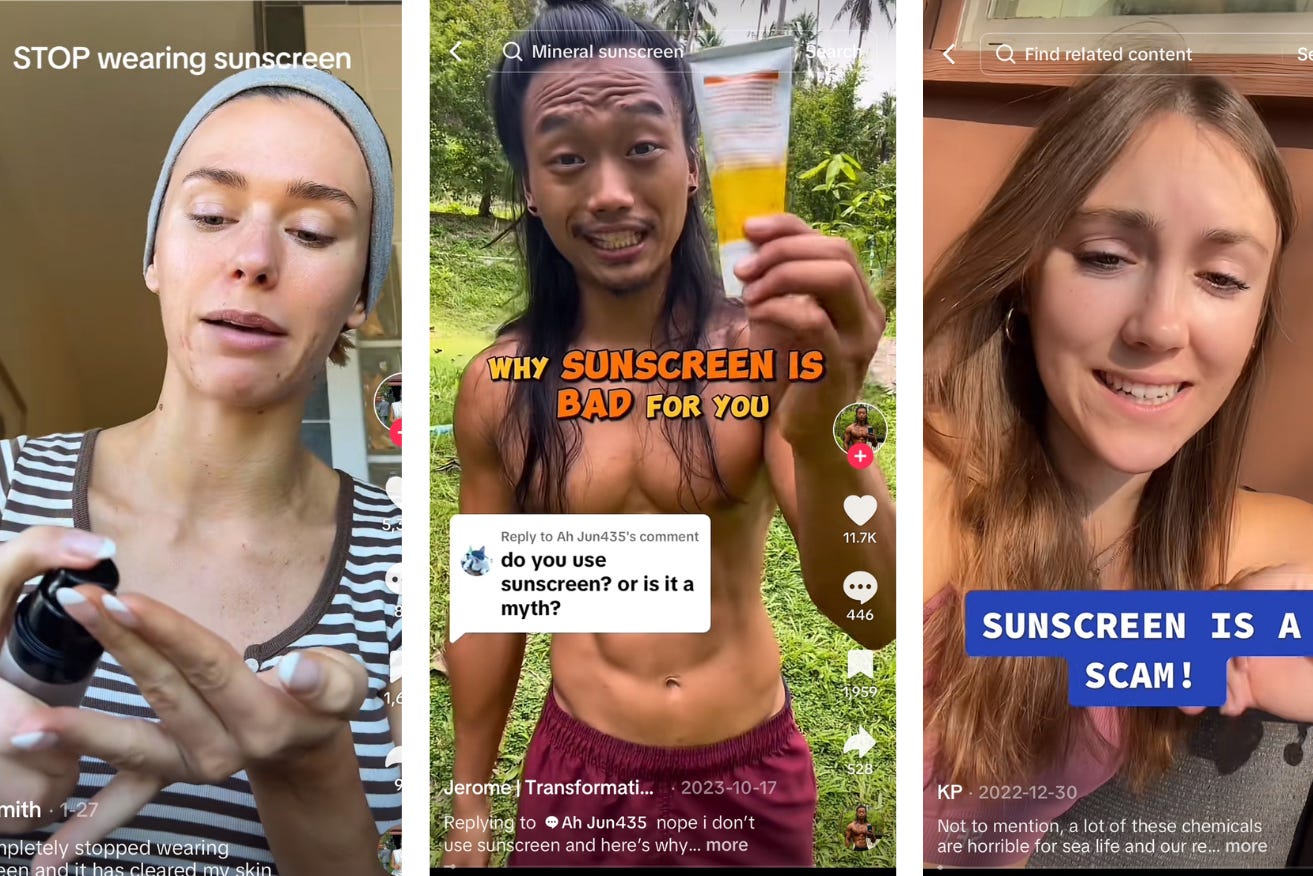
“Your skin absorbs everything you put on it” is one of the most repeated claims in clean beauty and wellness. It’s also, chemically speaking, mostly wrong, and the real story is far more reassuring.
I’ve thought for a long time about how to write this one. Because convictions run deep, especially the ones built on fear. Fear for our health, our safety, the people we love. That fear is reasonable. It isn’t a character flaw. It’s what makes you a careful person. And it’s exactly why clean beauty and the wider wellness movement, and their loudest claims ('‘sunscreen causes cancer”, “your skin is a sponge that drinks in 60% of whatever you put on it”) travel so fast and feel so true.
Here’s something you should know about me before you read another word: I was trained to doubt. Not the cynical, believe-nothing kind, but the disciplined kind. Before I formulated skincare for a living, I spent enough time running clinical tests, and the first thing science teaches you is to proportion your trust to the evidence: believe a claim exactly as much as the data behind it earns, no more. Ask who measured it. Ask how. Ask what the number actually means. And it works not because scientists are superhuman. We’re as biased as anyone. It works because the method is built to catch us when we slip: show your data, repeat the test, let other people try to pull it apart.
So, when you feel sceptical about what you put on your skin? Good.
I want you to be.
That instinct is exactly right. I’d just ask one thing: point it in every direction.
The real problem was never doubt. It’s selective doubt, the kind that interrogates the claim you dislike and waves through the one you already believe. And right now, it’s the clean beauty claims sailing through unchecked.
Being sceptical also means being willing to be wrong, and I have been, more than once. I’ve believed things about certain ingredients that newer, better data later made me quietly walk back. That’s not embarrassing. In science, it’s the actual job.
So I’m not writing this from a pedestal. I’m someone who has changed her mind before and fully expects to again.
Let me be clear about what this is not. It isn’t a takedown of clean beauty. I genuinely like a lot of what those brands make. Quick examples: ILIA, Saie and Pai put out clever, functional formulas, and I reach for them myself. I’m not against clean beauty. I’m against a few specific, unsubstantiated claims that can actually hurt people, and I think you already know the big one. The sunscreen scare.
Those claims sit on a spectrum, and the ends aren’t the same. It runs from the fairly cautious (switch to mineral, avoid oxybenzone) all the way to the genuinely reckless (don’t wear sunscreen at all).
I’m aiming at the claims, not at you, and not at the good brands working in this space.
It’s worth knowing one thing up front, too: “clean” isn’t a scientific term. There’s no regulatory definition of it, not from the FDA, not in the EU. No agreed list, no standard, no body that certifies it. Each brand and retailer draws its own line about what counts as “clean” or “natural” and what gets banished to the “nasties” list. Which means the word can mean almost anything the person using it wants it to mean. I’ll let you sit with what that implies.
So if you’ve been scanning everything through the Yuka app, or you’ve switched to zinc-only, or you’ve quietly stopped wearing sunscreen altogether, I’m not going to make you feel silly for it. You got there by trying to do the right thing. I’d just ask you to pause for a second. Not to be lectured at. Just to talk, one person to another, with someone every bit as worried about her own health and her family’s as you are about yours. I mean that.
I’ll make you two promises. I won’t exaggerate to frighten you, and I won’t hide or soften the parts that are genuinely true, because some of them are, and you deserve the whole picture, not the comfortable half of it. Then you can make up your own mind.
Because here’s my honest position: the answer to bad fearmongering is never more fearmongering pointed the other way. It’s perspective. And I happen to have a useful vantage point for it. I spend my working life trying to get ingredients into skin, and being humbled, over and over, by how good skin is at keeping them out. So let me show you what it’s actually doing.
The barrier you’re standing in right now
Picture a brick wall. Not a flimsy one, but a proper, well-built wall where the bricks are packed tight, and the mortar between them is waterproofed.
That’s your stratum corneum (the outermost layer of your skin, literally “horny layer” in Latin, because it’s made of tough, dead, flattened cells). Scientists have described it as “brick and mortar” for decades, and the metaphor is almost too on the nose. The dead skin cells are the bricks. The fatty lipids between them, the ceramides, cholesterol, and fatty acids packed into neat crystalline layers, are the mortar.
This layer is roughly the thickness of a sheet of cling film, and it is the single reason you don’t dissolve in the bath. It’s not a sponge soaking things up. It’s a raincoat keeping things out.
So when someone tells you your skin “drinks in” your serum, the chemistry-literate response is: with what? Through what? Because that wall was specifically, evolutionarily built to stop exactly that.
The 500 Dalton “rule”
Even if a molecule wants to get through the wall, it has to be small enough to squeeze between the bricks. And there’s a famous rule of thumb for this.
In 2000, two dermatologists, Bos and Meinardi, published what’s now called “the 500 Dalton Rule” (a Dalton is just a unit of molecular weight, a way of measuring how “heavy,” and roughly how big, a molecule is).
Their observation was simple and powerful: almost every substance that successfully penetrates skin, every common allergen, every topical drug, every nicotine and HRT patch on the market, is under 500 Daltons. Go bigger than that, and skin essentially says no entry.
Think of it as a nightclub with a strict door policy. Small molecules like glycolic acid (76 Daltons) walk straight in. But hyaluronic acid, the famous “plumping” ingredient, is often over a million Daltons. It’s the equivalent of trying to get a double-decker bus through the front door. It physically cannot penetrate. It sits on the surface holding water, which is genuinely useful! But it is not “getting deep into your skin,” no matter what the ad says.
And size is only the headline. The 500 Dalton figure is a powerful predictor, but it’s a simplification: what gets through depends on more than weight alone. A molecule also has to be a bit oily and a bit water-loving at once, since it has to dissolve into that greasy mortar and then back out into the watery layers underneath. Too greasy or too water-loving, and it gets stuck.
And even when something clears the size limit, two more gatekeepers can turn it away: an electrical charge (the greasy barrier repels “ionised,” charged molecules) and a strong appetite for hydrogen bonding (molecules studded with water-grabbing groups cling to the wet layers instead of slipping through the fat). This is why so many “actives” you apply work mostly in the very top layers, which, to be clear, is often exactly where you want them.
One honest refinement, because a sharp formulator will be itching to raise it: the 500 Dalton rule describes passive absorption, a molecule drifting through on its own, down a concentration gradient. We can and do cheat it, with liposomes and encapsulation (microscopic delivery capsules), nanoparticles, penetration enhancers, or microneedles that physically pierce past the barrier. But look at what that actually takes: deliberate, often expensive engineering, just to coax one larger molecule through. And even when it works, it usually means getting that molecule into the deeper skin layers (which is the whole point of a good active), not into your bloodstream.
Penetrating your skin and reaching your circulation are two completely different finish lines, and the second is far harder to cross. The barrier doesn’t fail here; it sets the terms.
“But it DOES get absorbed!” Let’s put that in perspective
Here’s where the honest conversation gets interesting, because the worry here isn’t entirely baseless. Some things do get through. Skin is a brilliant barrier, not a perfect one.
But “it gets absorbed” and “it harms you” are two completely different sentences, and the entire fear industry depends on you not noticing the gap between them.
The principle every toxicologist lives by is: the dose makes the poison.
Water will kill you at a high enough dose. Oxygen, at high enough pressure, is toxic. Everything is a poison at some dose and harmless below it. So “Chemical X was detected in your blood” tells you almost nothing on its own. The only question that matters is: how much, and is that amount biologically meaningful?
Two analogies I keep coming back to.
The shark on the telly. A great white shark is genuinely hazardous. A great white shark on your TV screen poses you zero risk. The difference is exposure. Toxicologists separate hazard (could this cause harm in principle?) from risk (will it actually, given how much you’re exposed to?). Clean beauty and wellness sells you the shark and quietly leaves out the part where it’s on a screen behind glass.
The locked-door industry. If skin really “absorbed everything,” then getting medicines into the body through skin would be easy. It is the opposite of easy. There is an entire field of pharmaceutical science devoted to inventing penetration enhancers: ingredients like specific alcohols and fatty acids whose only job is to force open that lipid mortar so a drug can sneak through. We have to fight the skin, hard, to deliver even modest amounts of medicine through it. That difficulty is the proof. You don’t build elaborate tools to break down a wall that isn’t there.
The big one: sunscreen and the “it’s in your blood” panic
This is the scare that sends people running to less effective products, so it deserves the most care.
In 2019 and 2020, the FDA ran two studies (published in JAMA, (here) and (here) where volunteers slathered chemical sunscreen over 75% of their body, four times a day. And yes, the filters showed up in their blood. The headlines wrote themselves: ”Sunscreen chemicals enter your bloodstream!”
All true. And here’s the context the headlines skipped.
The study used a threshold of 0.5 nanograms per millilitre as the level above which a chemical needs further testing. A nanogram is a billionth of a gram. That threshold isn’t a danger line. It’s the level below which the estimated cancer risk from a single dose is less than 1 in 100,000. It’s a conservative trigger to do more homework, not a verdict of harm.
And the most important line in the entire study was written by the FDA researchers themselves: these findings do not mean people should stop using sunscreen. The FDA’s official position was that Americans should keep using it. When the agency that ran the scary study tells you to keep doing the thing, that should tell you something.
What about oxybenzone, the filter with the worst reputation? It does have weak oestrogen-like activity in a petri dish, and at very high doses fed to rats it had effects. But here’s the perspective that should end the conversation: a 2011 analysis in the Archives of Dermatology calculated how long you’d have to use sunscreen daily to reach the dose those rats received, per unit of body weight.
The answer was between 34 and 277 years.
Not days. Not months. Centuries. That’s the gap between “detectable” and “dangerous.”
(My honest caveat, because I won’t pretend the science is fully closed: regulators like the EU’s safety committee have lowered the permitted concentration of oxybenzone as a precaution, and the real uncertainty is around developing foetuses and young children. So if you’re pregnant or buying for a child and you want to be cautious, that’s completely reasonable, and there’s a perfect option below.)
Mineral sunscreens, zinc oxide and titanium dioxide, basically don’t absorb at all. Multiple studies show the particles sit on top of skin and in its grooves. In one study, less than 0.03% of the zinc applied got past the outer layer, statistically no different from the placebo. So if absorption worries you, mineral filters are your friend.
But here’s the honest catch: “barely absorbs” comes with a real-world cost.
Mineral formulas tend to be heavier and greasier, and they often leave a white cast (which is worse, and more visible, on deeper skin tones). And here’s the problem with a sunscreen that feels unpleasant: people use less of it, and reapply it less often. That matters enormously, because SPF is measured in the lab at a generous 2 milligrams per square centimetre, far more than most of us ever actually apply.
Protection doesn’t drop off neatly in proportion to how little you use; it falls away steeply. Apply half the tested amount, and you don’t get half the protection. You can lose far more than that. So a mineral sunscreen that sits in the drawer because it’s a pain to wear, or gets dotted on in a thin, cast-dodging layer, can leave you less protected than an elegant chemical filter you’ll happily slather on and top up.
This is the part the “just switch to mineral” advice skips: the best sunscreen isn’t the one with the most reassuring ingredient list. It’s the one you’ll actually wear properly, every day. What you should not do is skip sun protection altogether. The sun is the shark that’s actually in the water with you.
Parabens, “natural,” and the myth that started it all
The entire paraben panic traces back to a single 2004 study that found parabens in samples of breast tumour tissue. That’s it. That’s the whole foundation.
The problem? The study had no healthy tissue to compare against (so we have no idea if the levels were even elevated), it never showed parabens caused anything, and it couldn’t say how they got there. The lead author, Philippa Darbre, said outright that her finding could not be taken to mean parabens caused the cancer. Other scientists pointed out the obvious: finding a substance somewhere is not the same as it doing harm. Parabens do have oestrogen-like activity, thousands to a million times weaker than the oestrogen your own body makes every single day.
But what does “weaker” actually mean once it’s in you?
Picture your oestrogen receptors as locks, and your own oestrogen as the key cut to fit them perfectly. A paraben is a badly made copy of that key: it can rattle into the lock, but it grips poorly and barely turns it.
Now picture that your real oestrogen is everywhere, vastly outnumbering the trace of paraben that makes it into your tissues, and it grips the lock far more tightly. So the weak imposter is outcompeted before it can do much, only feebly switches on the receptor on the rare occasion it does bind, and is then broken down and cleared by your body within hours. Two things stacked in your favour: barely any gets in, and what does is a feeble actor swimming against a tide of your own, far stronger hormone.
(This is also why parabens can look alarming in a lab study: strip away your natural oestrogen in a petri dish, and the weak imposter finally has the place to itself. But you are not a petri dish.)
Parabens have been reviewed for over twenty years by regulators on multiple continents and judged safe at the levels used. They’re also superb, gentle preservatives. We replaced them, in many cases, with alternatives that turned out to cause far more allergic reactions (more on that in a second).
And then there’s the word ”natural,” which I’d like to retire from skincare marketing forever. Natural tells you nothing about safety. Poison ivy is natural and organic. Botulinum toxin, the most poisonous substance known, is natural.
Meanwhile, lavender and tea tree oil, the poster children of “gentle and natural,” were linked in a 2007 New England Journal of Medicine report to abnormal breast development in young boys, because both oils have hormone-like activity. The symptoms resolved when the products were stopped.
(Honest caveat again: that was three case reports plus lab data, not proof at a population level. But that’s the point: “natural” essential oils were the ones showing hormonal effects, while the dreaded “chemical” parabens are sitting in your moisturiser doing nothing but stopping it from growing mould.)
“Chemical-free” is not a thing. Water is a chemical. You are made of chemicals. The word is meaningless, and it’s designed to be.
Two more names on the watchlist: BHT and PEGs
If you’ve scanned a product recently, these two probably lit up red, and each is “scary” for a different reason, which is the tell. Once you spot the pattern, the rest of the watchlist gets far less frightening.
BHT is a fear built on high-dose animal studies, and it’s a genuinely reassuring case, because the regulators actually went looking. BHT is a synthetic antioxidant that stops a product’s oils going rancid (it’s also a permitted food antioxidant, E321, that you’ve almost certainly eaten). It was flagged as a suspected endocrine disruptor, so the EU’s safety committee reviewed it with exactly that worry in mind, and in 2021 concluded it’s safe at cosmetic use levels (up to 0.8% in most products). That’s not a box nobody ticked. That’s the system working as designed.
PEGs are the more interesting case, because the worry points at the right thing but the wrong culprit. The PEGs themselves are large, well-tolerated, and reviewed as safe as used.
The genuine concern is a contaminant: 1,4-dioxane, a probable carcinogen that can form as a byproduct when PEGs are manufactured (a process called ethoxylation). But it’s an impurity, not an ingredient, and purification removes it: the FDA monitors it, levels have dropped sharply as manufacturing improved, and trace amounts (≤10 ppm) are considered safe.
So the honest takeaway isn’t “PEGs are poison,” it’s “buy from manufacturers who purify properly,” which reputable ones do. (One real caveat: PEGs can nudge absorption up a little, so they’re best kept off broken or burned skin. Intact skin is fine.)
See the pattern? A fear the regulators chased down and closed, and a real contaminant that good manufacturing already controls. Neither is the silent poisoner a red “scan score” makes it look.
Where the risk is actually real (because honesty matters)
I’d be a hypocrite if I told you nothing ever matters. So here’s where genuine, evidence-based caution belongs, and notice none of it is the vague “toxins” story.
Allergic reactions are the real risk, not poisoning. The biggest preservative scandal of the last decade wasn’t parabens. It was methylisothiazolinone (MIT), a paraben replacement that triggered such an epidemic of allergic contact dermatitis that it was named Contact Allergen of the Year in 2013 and is now banned from leave-on products in the EU. Irritation and allergy are local, real, and dose-dependent, and a world away from systemic “toxicity.”
Salicylic acid over large areas is the genuine exception, especially on children. Slathering high concentrations over big patches of skin (particularly on babies and toddlers) can cause salicylate toxicity. A BHA spot treatment on an adult’s chin? Fine. A whole-body application on a small child? Not fine.
Broken, inflamed, or baby skin is a different animal entirely. Every reassuring number above assumes intact, healthy, adult skin. Damage the barrier (eczema, wounds, raw skin) and absorption shoots up. Infant skin is thinner and has a far higher surface-area-to-body-weight ratio, which is exactly why paediatric warnings exist. Context is everything.
So, what do you actually do with all this?
Wear your sunscreen every day, the chemical or mineral one you’ll actually reapply. If absorption worries you, mineral is a great choice; just apply it generously and reapply, since a thin, cast-dodging layer protects far less than the label promises.
Stop fearing the usual watchlist names (parabens, phenoxyethanol, acrylates, BHT, PEGs); the evidence doesn’t support the panic, and the preservatives among them are keeping your products from turning into a petri dish.
Take allergies seriously: patch-test new actives, and be cautious with fragrance and with older or imported products if your skin is reactive. Be genuinely careful with strong actives on broken skin and on small children.
And the next time someone tells you your skin “absorbs everything,” you can smile and tell them the truth: your skin is one of the most sophisticated barriers in the entire natural world. It’s not a sponge waiting to soak up danger.
It’s a raincoat. And it’s very, very good at its job.
I’ll see you next week,
Complexions x
As always: I’m a cosmetic chemist, not your doctor. If you have a specific medical condition, are pregnant, or are treating a child, talk to a professional who knows your situation. Everything above is the science as it stands; I’ve linked the studies so you can read the originals yourself. That’s the whole point. Don’t take my word for it.
Great article, thank you! You should get an award for debunking myths. I've been using SPF for years, exclusively Korean and sometimes Japanese ones. I have the least confidence in anything called "natural." I think it's a marketing ploy that exploits people's tendency to fear. When someone says chemicals are bad, I'm astonished. After all, our bodies are one giant chemical factory. I prefer a well-formulated, fragrance-free chemical product to anything labeled "natural," not to mention that natural oils very often cause allergic reactions and my skin is prone to allergies.
Succinctly written. The fear mongering is out of control. I'm sharing this with tonnes of people in the hope they will come to their senses.